
Abstract:
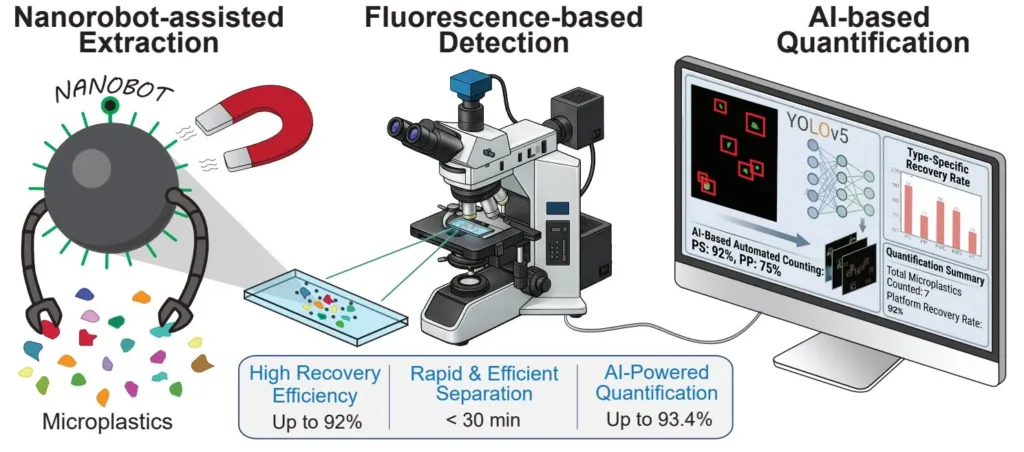
Microplastic accumulation in water demands rapid and scalable extraction and detection methods. Conventional extraction approaches, such as density separation and oil-based extraction, are limited by long processing times, hazardous reagents, and poor scalability. Here, we present an integrated magnetic nanorobot-assisted platform for the extraction and quantitative detection of microplastics. Two surface-engineered magnetite sorbents, HDTMS-modified Fe3O4 nanoparticles and silica-coated Fe3O4 (Fe3O4@SiO2) nanorobots, are used to capture microplastics from spiked samples. The extracted particles are stained with rhodamine B, imaged by fluorescence microscopy, and automatically quantified using a pre-trained YOLOv5 model. Comparative recovery analysis shows polymer-dependent extraction behavior: HDTMSmodified Fe3O4 performs better for nonpolar polymers such as polypropylene (PP) and polyethylene (PE), whereas Fe3O4@SiO2 provides higher recovery for aromatic or relatively polar polymers such as polystyrene (PS) and polyvinyl chloride (PVC). The proposed method combines rapid processing, high recovery, low chemical burden, and automated quantification, providing a promising route for scalable microplastic monitoring in aquatic environments.
DOI: 10.1109/JSEN.2026.3747911
Lamiya Dewan, Salman Abdullah Shovon, Md. Shadman Mostafa
Comments