
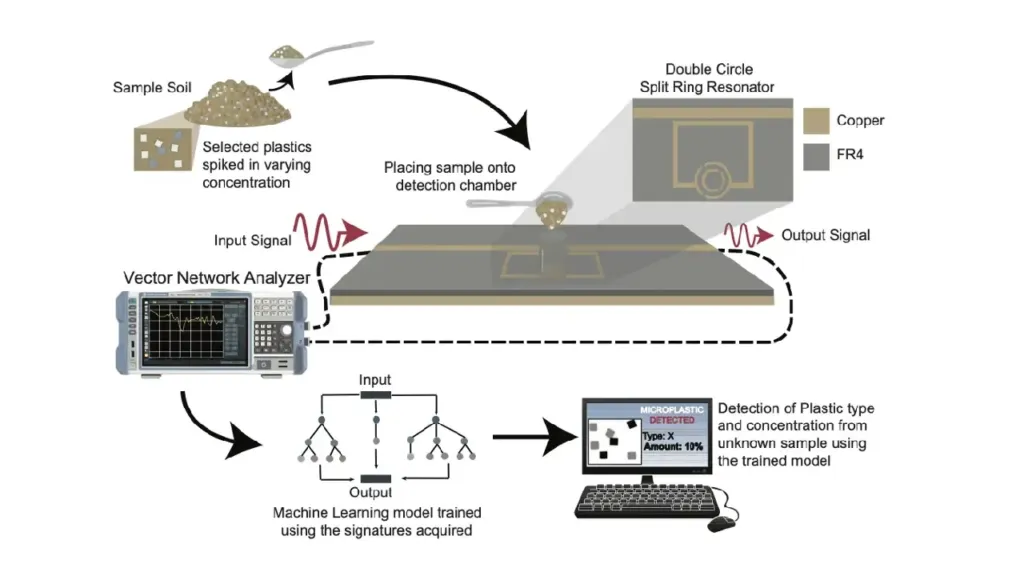
Abstract:
Microplastics are common environmental contaminants that pose serious threats to ecosystems and human health. Detecting microplastics is challenging and time-consuming, and often requires specialized laboratories, expert knowledge, and lengthy procedures. Here, we introduce “SensorPlast,” a microwave sensor based on an asymmetric split-ring resonator (ASRR) combined with machine learning (ML) to identify the microplastic polymer type and concentration in soil samples. In addition to being low-cost and field-deployable, SensorPlast offers several key advantages that include: 1) high sensitivity of 1.68 MHz/% (w/w) for polypropylene (PP), and 4.5 MHz/% (w/w) for acrylonitrile butadiene styrene (ABS) microplastics in soil; 2) ability to identify ABS due to its unique solubility in acetone, with a lower limit of detection (LOD) of 0.99 mg/g (0.099% w/w) and sensitivity of 3.3 MHz/% (w/w); and 3) prediction of polymer type and concentration with high precision. We apply SensorPlast and the selective identification protocol to detect ABS in coastal soils ( 21∘24 ’54.9”N, 91∘58 ’55.4”E). SensorPlast identifies ABS with over 80% confidence. The unique combination of microwave-based sensing with advanced ML techniques, therefore, makes SensorPlast a cost-effective, portable, and reliable tool for fast and accurate detection of microplastics in environmental samples.